Office of the Commissioner for Federal Judicial Affairs Canada's 2026-27 Departmental Plan
On this page:
- At a glance
- From the Commissioner
- Plans to deliver on core responsibility and internal services
- Planned spending and human resources
- Federal tax expenditures
- Corporate information
- Definitions
Copyright Information
© His Majesty the King in Right of Canada, as represented by the Minister of Justice and Attorney General of Canada, 2026
ISSN: 2371-834X
At a glance
This departmental plan details the Office of the Commissioner for Federal Judicial Affairs Canada’s priorities, plans, and associated costs for the upcoming three fiscal years.
These plans align with the priorities outlined in the Mandate Letter, as well as the Office of the Commissioner for Federal Judicial Affairs Canada’s Vision, mission, raison d’être and operating context.
Key priorities
The Office of the Commissioner for Federal Judicial Affairs Canada (FJA) identified the following key priorities for 2026-27:
- Optimize existing digital tools to streamline the judicial appointments process, enhance collaboration and maintain process integrity and timeliness.
- Enhance departmental effectiveness by modernizing information technology tools and services.
- Undertake the activities necessary to transition to a new pension payment platform for retired judges.
Comprehensive Expenditure Review
The government is committed to restraining the growth of day-to-day operational spending to make investments that will grow the economy and benefit Canadians.
Because of its mandate, FJA is not subject to planned reductions under the Comprehensive Expenditure Review. FJA will, however, respect the spirit of the exercise by doing the following:
- Undertake ongoing reviews of departmental expenditures to identify efficiencies in day-to-day operational spending where feasible.
- Streamline procurement activities and focus on purchases from Canadian vendors first.
- Continue leveraging digital tools and business processes to reduce paper use, printing, mailing and courier costs.
This departmental plan reflects these measures.
Highlights for the Office of the Commissioner for Federal Judicial Affairs Canada in 2026-27
FJA’s focus is on supporting judges and promoting judicial independence. In 2026–27, this support will be guided by the organization’s key priorities. Building on work initiated in the latter part of the previous fiscal year, FJA will continue to optimize existing digital tools to streamline the judicial appointments process and enhance collaboration. These efforts aim to reduce administrative burden, safeguard process integrity, and improve accessibility and efficiency for applicants seeking appointment to superior courts across Canada. FJA will enhance departmental effectiveness by continuing investment, development and training initiatives in information technology tools and services. This includes implementing a new judicial pensions management system to replace an aging legacy system, exploring the emerging trend of artificial intelligence and its applicability to our areas of work, as well as maintaining secure platforms that support judicial communication and access to essential resources. Collectively, these initiatives contribute to an independent, effective, and accountable judiciary, and reinforcing public confidence in the administration of justice. Finally, FJA’s International Program Division will advance a multi-pronged approach through two complementary streams of work: short-cycle initiatives delivered under the Technical Assistance Partnership (TAP) program, and the multi-year Equal Justice for All in Mongolia (EJAM) project.
In 2026-27, total planned spending (including internal services) for FJA is $930,623,440 and total planned full-time equivalent staff (including internal services) is 72.
Summary of planned results
The following provides a summary of the results the department plans to achieve in 2026-27 under its main areas of activity, called “core responsibilities.”
Core responsibility: Services and support to federally appointed judges
In 2026-27, FJA will continue to provide comprehensive services and support to federally appointed judges, as well as pensioners and survivors. This includes administering judicial appointments, remuneration and expense management, providing language training, supporting international judicial cooperation, and publishing Federal Courts Reports. The Canadian Judicial Council will continue prioritizing judicial education and professional development while administering and refining the judicial conduct regime. Together, these efforts strengthen an independent and effective judiciary and promote public confidence in the administration of justice.
Planned spending: $928,792,185
Planned human resources: 61
More information about Services and support to federally appointed judges can be found in the full plan.
For complete information on FJA’s total planned spending and human resources, read the Planned spending and human resources section of the full plan.
From the Commissioner

Marc A. Giroux
Commissioner
I am pleased to present the 2026-27 Departmental Plan for the Office of the Commissioner for Federal Judicial Affairs (FJA). This plan provides parliamentarians and Canadians with an overview of the initiatives and activities we will undertake in the coming year.
Key priorities for FJA in 2026-27 are to continue to enhance our support to the judiciary, building on progress made in previous years while advancing new initiatives. We will carry on with modernizing the judicial appointments process to ensure timely, fair, and transparent assessments. We will also support judges with the tools, education, and training they require to exercise their duties. In addition, FJA will enhance departmental effectiveness by modernizing information technology tools and services, ensuring that our operations remain efficient, secure, and responsive.
FJA’s International Cooperation division will pursue the advancement of Canada’s commitment to judicial excellence abroad through programs such as the Technical Assistance Partnership, supporting Canadian judges engaged in these initiatives and promoting the rule of law internationally.
The Secretariat of the Canadian Judicial Council will continue to support judicial education, professional development, and the administration of the judicial conduct regime, helping to maintain public confidence in the administration of justice.
I invite you to read our Departmental Plan to learn more about our plans and priorities for 2026-27.
Plans to deliver on core responsibility and internal services
Core responsibility and internal services
Core responsibility: Services and support to federally appointed judges
In this section
- Description
- Quality of life impacts
- Indicators, results and targets
- Plans to achieve results
- Gender-based Analysis Plus
- Planned resources to achieve results
- Program inventory
- Summary of changes to reporting framework since last year
Description
The provision of services and support to federally appointed judges in superior courts across Canada in a manner that safeguards the independence of the judiciary.
Quality of life impacts
Domain: Good Governance
Indicators: Confidence in institutions, representation in senior leadership positions, access to fair and equal justice
Indicators, results and targets
This section presents details on the department’s indicators, the actual results from the three most recently reported fiscal years, the targets and target dates for Services and support to federally appointed judges. Details are presented by departmental result.
Table 1: Federally appointed judges are provided with centralized services in a timely and effective manner
Table 1 provides a summary of the target and actual results for each indicator associated with the results under Services and support to federally appointed judges.
|
Departmental Result Indicators |
Actual Results |
2026–27 Target |
Date to achieve target |
|
% of judges’ allowances processed within the 10-day service standard |
2022-23: 43% 2023-24: 80% 2024-25: 85% |
90% |
March 2027 |
Table 2: The judicial appointments process is managed efficiently
Table 2 provides a summary of the target and actual results for each indicator associated with the results under Services and support to federally appointed judges.
|
Departmental Result Indicators |
Actual Results |
2026–27 Target |
Date to achieve target |
|
% of candidate applications processed and assigned to a Judicial Advisory Committee within 3 months of reception |
2022-23: N/A* 2023-24: N/A* 2024-25: N/A* |
95% |
March 2027 |
*Actual results for prior years are unavailable due to refinements to departmental results indicators that improved clarity and reporting accuracy, making comparisons with previous years invalid.
Table 3: Members of the Canadian public are provided with a mechanism for filing a complaint against a federally appointed judge in relation to their judicial conduct
Table 3 provides a summary of the target and actual results for each indicator associated with the results under Services and support to federally appointed judges.
|
Departmental Result Indicators |
Actual Results |
2026–27 Target |
Date to achieve target |
|
% of complaints reviewed annually |
2022-23: N/A* 2023-24: N/A* 2024-25: N/A* |
80% |
March 2027 |
*Actual results for prior years are unavailable due to refinements to departmental results indicators that improved clarity and reporting accuracy, making comparisons with previous years invalid.
Additional information on the detailed results and performance information for FJA’s program inventory is available on GC InfoBase.
Plans to achieve results
The following section describes the planned results for Services and support to federally appointed judges in 2026-27.
The Office of the Commissioner for Federal Judicial Affairs (FJA) is dedicated to providing comprehensive services and support to approximately 1,200 federally appointed judges across Canada, as well as to roughly 1,200 pensioners and their survivors. In addition to administering judicial remuneration and reimbursing expenses incurred in the performance of judicial duties, FJA supports key judicial functions such as judicial appointments, international cooperation, judges’ language training, and the publication of Federal Courts Reports.
In parallel, the Canadian Judicial Council (CJC) plays a critical role in maintaining public confidence in the judiciary. The CJC supports the work of the Judicial Education Committee by collaborating with a range of organizations to facilitate access to high-quality, ongoing judicial education and professional development for federally appointed judges, helping them address emerging legal, societal, and technological challenges. The CJC also oversees the review and assessment of complaints regarding judicial conduct, promoting accountability while safeguarding judicial independence.
Collectively, these activities help ensure that Canadians are served by a judiciary that is independent, effective, and widely respected.
Judicial Appointments
Within its responsibility for administering the judicial appointments process on behalf of the Government of Canada, FJA supports the work of 17 Judicial Advisory Committees and manages more than 50 committee meetings annually across the country. FJA will continue to support the timely and fair assessments of candidates seeking appointment to the superior courts of Canada. This includes the accurate and timely preparation of supporting documentation and submissions for appointments to the various courts. Building on recent modernization efforts, FJA will further refine the electronic application process and leverage digital tools to improve efficiency, accessibility, and support for committee operations. FJA will also continue to promote transparency by publishing annual statistics on its website related to judicial applicants and appointees.
International Cooperation
In 2026–27, FJA will deliver focused international judicial cooperation that advances the rule of law, good governance and access to justice. Activities will be organized around two complementary streams. Through the Technical Assistance Partnership (TAP) program, funded by Global Affairs Canada, FJA will support a small number of short-term, demand-driven initiatives in selected countries. These initiatives will respond to locally identified priorities and may address areas such as Indigenous justice, judicial ethics, court administration or youth justice. In parallel, the Equal Justice for All in Mongolia (EJAM) project will continue into implementation, supporting stronger judicial coordination, expanded judicial education, enhanced judicial independence and increased institutional capacity.
Across all international activities, FJA will strengthen support for Canadian judges engaged in this work by improving the identification and use of judicial expertise, providing clearer guidance and expectations, and offering a centralized bilingual online resource that brings together policies, tools and security information.
Judges’ Language Training
FJA continues to offer comprehensive language training tailored to the specific needs of judges. This includes individualized and intensive instruction, as well as immersive learning sessions, in Canada’s two official languages.
In 2026-27, learning modules and instructional materials will be reviewed and updated to reflect developments in the legal field, evolving legal terminology, and the diversity of the Canadian population. Updates will also incorporate emerging pedagogical, andragogical, and educational technology approaches. In addition, operational guidelines for language training will be revised to ensure they remain agile, efficient, and learner centered.
Federal Courts Reports
For 2026-27, FJA will continue to ensure Canadians have reliable access to the decisions and summaries of the Federal Court of Appeal and the Federal Court in both official languages. Efforts will focus on publishing decisions more quickly while upholding the high quality and accuracy of the reports. To support timely access, internal processes will be further strengthened to improve the efficiency and consistency of case selection, headnote preparation, and translation.
Compensation and Benefits
The Office of the Commissioner is responsible not only for administering the pay of active federally appointed judges across Canada, but also for administering their pensions upon retirement and, where applicable, pensions for their survivors. The current pension system is administered through the outdated legacy Regional Pay System. Following in-depth consultations with Public Services and Procurement Canada, FJA will take the necessary steps in 2026-27 to implement a modernized pension system. This will ensure that FJA continues to fulfill its mandate by providing accurate and secure pension administration for retired judges and their survivors, using the tools necessary to safeguard sensitive information and support reliable payments.
Canadian Judicial Council
Under the direction of the 44 Chief Justices and Associate Chief Justices across Canada, the Canadian Judicial Council (CJC) Secretariat works to sustain public confidence in federally appointed judges by promoting efficiency and uniformity and improving the quality of judicial services in all superior courts in Canada.
Administering the judicial conduct regime remains a key activity and ongoing priority for the Council and its Secretariat in the coming fiscal year. The Council continues to experience an increase in the overall number of complaints received, as well as in the number of complaints proceeding beyond the initial screening stage. This trend is largely attributable to amendments to the judicial conduct regime that came into force in June 2023. To manage the associated operational pressures, the Secretariat sustains the work of the Judicial Conduct Committee in refining complaint review procedures and related processes, with a view to ensuring fairness, efficiency, and transparency, while strengthening capacity, including through additional human resources.
Another key priority for the Council is ensuring that federally appointed judges have access to high-quality, effective, and ongoing judicial education and professional development. The Secretariat will continue to support the work of the Judicial Education Committee by collaborating with a range of organizations to deliver meetings, seminars, and conferences that enhance judicial education. These initiatives complement court-specific education programs and judges’ self-directed professional development activities.
The 2026-27 fiscal year will also see the launch of innovative initiatives focused on technological advancement and public education, further supporting the Council’s mandate and enhancing transparency and public understanding of the justice system.
Gender-based Analysis Plus
FJA integrates Gender-based Analysis Plus into the management of its internal operations under its core responsibility of providing services and support to federally appointed judges. The organization does not deliver programs or benefits to individual Canadians and therefore does not generate program-level data for assessing gender or diversity impacts. To address this, FJA monitors internal indicators such as workforce composition, recruitment and retention trends, participation in training, and employee feedback to assess the effectiveness of its inclusive practices.
FJA regularly reviews its policies and procedures through an inclusion lens, identifies and addresses potential barriers that may affect employees differently, and promotes equitable access to development and workplace opportunities. These actions provide a practical way to measure gender, and diversity impacts within the department and ensure that internal operations support broader government objectives on equity and inclusion.
Planned resources to achieve results
Table 4: Planned resources to achieve results for Services and support to federally appointed
Table 4 provides a summary of the planned spending and full-time equivalents required to achieve results.
|
Resource |
Planned |
|
Spending |
928,792,185 |
|
Full-time equivalents |
61 |
Complete financial and human resources information for FJA’s program inventory is available on GC InfoBase.
Program inventory
Services and support to federally appointed judges are supported by the following programs:
- Payments pursuant to the Judges Act
- Office of the Commissioner for Federal Judicial Affairs
- Canadian Judicial Council
Additional information related to the program inventory for Services and support to federally appointed judges is available on the Results page on GC InfoBase.
Summary of changes to reporting framework since last year
The description of FJA’s core responsibility was refined to better reflect the department’s role in providing administrative support that upholds judicial independence and public confidence. Updates were also made to several departmental results and indicators to improve clarity and alignment with operational practices. These updates include clearer indicator wording and more precise methodologies to ensure consistent and accurate performance reporting.
Internal services
In this section
- Description
- Plans to achieve results
- Planned resources to achieve results
- Planning for contracts awarded to Indigenous businesses
Description
Internal services are the services that are provided within a department so that it can meet its corporate obligations and deliver its programs. There are 10 categories of internal services:
- acquisition management services
- communications services
- financial management services
- human resources management services
- information management services
- information technology services
- legal services
- material management services
- management and oversight services
- real property management services
Plans to achieve results
This section presents details on how the department plans to achieve results and meet targets for internal services.
Through ongoing modernization initiatives, internal services will help ensure the department can deliver its priorities efficiently and effectively. In 2026-27, FJA will focus on the following key internal services actions:
- Support a healthy, safe and respectful workplace that promotes employee well-being and a positive work environment.
- Strengthen diversity, inclusion, employment equity and accessibility by using workforce data to better understand representation and guide actions to address gaps.
- Manage financial, human and information resources responsibly to support effective operations and decision-making.
- Enhance departmental processes through IT modernization, including implementing a new system to manage pensions under the Judges Act and maintaining a secure, independent networking platform for federally appointed judges.
- Deliver timely and accurate payments to judges, including salaries and allowances under the Judges Act, as well as payments to eligible pensioners and survivors.
Planned resources to achieve results
Table 5: Planned resources to achieve results for internal services this year
Table 5 provides a summary of the planned spending and full-time equivalents required to achieve results.
|
Resource |
Planned |
|
Spending |
1,831,255 |
|
Full-time equivalents |
11 |
Complete financial and human resources information for FJA’s program inventory is available on GC InfoBase.
Planning for contracts awarded to Indigenous businesses
FJA has established procurement strategies to support achieving the goal of awarding at least 5% of the total value of contracts to Indigenous businesses each year. The organization will continue to review its procurement activities to pinpoint areas where Indigenous suppliers can be engaged. This approach includes involving the procurement team early in the planning process to assess Indigenous supplier capacity, as well as providing management with regular progress updates and recommendations on upcoming requirements that may be suited to Indigenous businesses.
Additionally, FJA staff responsible for procurement will continue to participate in training on federal procurement policies and on the considerations necessary to broaden contracting opportunities for Indigenous businesses across Canada.
Table 6: Percentage of contracts planned and awarded to Indigenous businesses
Table 6 presents the current, actual results with forecasted and planned results for the total percentage of contracts the department awarded to Indigenous businesses.
|
5% Reporting Field |
2024-25 Actual Result |
2025-26 Forecasted Result |
2026-27 Planned Result |
|
Total percentage of contracts with Indigenous businesses |
8.7% |
5% |
5% |
Planned spending and human resources
This section provides an overview of FJA’s planned spending and human resources for the next three fiscal years and of planned spending for 2026-27 with actual spending from previous years.
In this section
Spending
This section presents an overview of the department's planned expenditures from 2023-24 to 2028‑29.
Budgetary performance summary
Table 7: Three-year spending summary for core responsibility and internal services (dollars)
Table 7 presents FJA’s spending over the past three years to carry out its core responsibility and for internal services. Amounts for the 2025–26 fiscal year are forecasted based on spending to date.
|
Core responsibility and Internal services |
2023-24 Actual Expenditures |
2024-25 Actual Expenditures |
2025-26 Forecast Spending |
|
Services and support to federally appointed judges |
751,993,164 |
803,471,660 |
845,828,304 |
|
Subtotal |
751,993,164 |
803,471,660 |
845,828,304 |
|
Internal services |
726,800 |
726,800 |
1,691,888 |
|
Total |
752,719,964 |
804,198,460
|
847,520,192
|
Analysis of the past three years of spending
The actual spending for the department increases over each reporting period largely as a result of statutory provisions in the Judges Act as they relate to the annual increase in the salaries of federally appointed judges as a function of the industrial aggregate index applied on April 1 of each year and the increase in pension payments to retired judges and survivors as a function of the annual indexation applied on January 1 of each year.
More financial information from previous years is available on the Finances section of GC Infobase.
Table 8: Planned three-year spending on core responsibility and internal services (dollars)
Table 8 presents FJA’s planned spending over the next three years by core responsibility and for internal services.
|
Core responsibility and Internal services |
2026-27 Planned Spending |
2027-28 Planned Spending |
2028-29 Planned Spending |
|
Services and support to federally appointed judges |
928,792,185 |
975,092,250 |
1,033,246,130 |
|
Subtotal |
928,792,185 |
975,092,250 |
1,033,246,130 |
|
Internal services |
1,831,255 |
1,831,255 |
1,831,255 |
|
Total |
930,623,440 |
976,923,505 |
1,035,077,385 |
Analysis of the next three years of spending
The planned spending for the department increases over each reporting period largely as a result of statutory provisions in the Judges Act as they relate to the annual increase in the salaries of federally appointed judges as a function of the industrial aggregate index applied on April 1 of each year and the increase in pension payments to retired judges and survivors as a function of the annual indexation applied on January 1 of each year. As well, the departmental approach to determine whether planned spending is classified under FJA’s core responsibility versus internal services was reviewed and adjusted as part of the 2025-26 Departmental Plan, resulting in an increase in planned internal services in comparison to prior years.
More detailed financial information on planned spending is available on the Finances section of GC Infobase.
Funding
This section provides an overview of the department's voted and statutory funding for its core responsibility and for internal services. For further information on funding authorities, consult the Government of Canada budgets and expenditures.
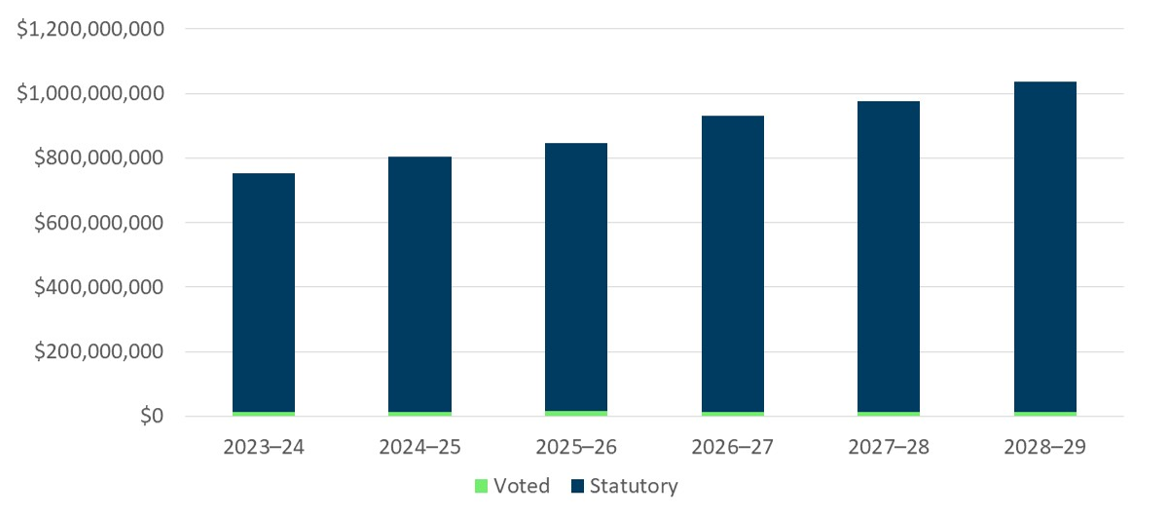
Graph 1: Approved funding (statutory and voted) over a six-year period
Graph 1 summarizes the department's approved voted and statutory funding from 2023-24 to 2028-29.
Text description of graph 1
|
Fiscal year |
Total |
Voted |
Statutory |
|
2023-24 |
752,719,964 |
13,258,680 |
739,461,284 |
|
2024-25 |
804,198,460 |
14,459,334 |
789,739,126 |
|
2025-26 |
847,520,192 |
14,603,432 |
832,916,760 |
|
2026-27 |
930,623,440 |
13,957,702 |
916,665,738 |
|
2027-28 |
976,923,505 |
13,957,702 |
962,965,803 |
|
2028-29 |
1,035,077,385 |
13,957,702 |
1,021,119,683 |
Analysis of statutory and voted funding over a six-year period
Spending for the department increases over each reporting period largely as a result of statutory provisions in the Judges Act as they relate to the annual increase in the salaries of federally appointed judges as a function of the industrial aggregate index applied on April 1 of each year and the increase in pension payments to retired judges and survivors as a function of the annual indexation applied on January 1 of each year.
For further information on FJA’s departmental appropriations, consult the 2026-27 Main Estimates.
Future-oriented condensed statement of operations
The future-oriented condensed statement of operations provides an overview of FJA’s operations for 2025-26 to 2026-27.
Table 9: Future-oriented condensed statement of operations for the year ended March 31, 2027 (dollars)
Table 9 summarizes the expenses and revenues which net to the cost of operations before government funding and transfers for 2025-26 to 2026-27. The forecast and planned amounts in this statement of operations were prepared on an accrual basis. The forecast and planned amounts presented in other sections of the Departmental Plan were prepared on an expenditure basis. Amounts may therefore differ.
|
Financial information |
2025-26 Forecast |
2026-27 Planned results |
Difference (Planned results minus forecasted) |
|
Total expenses |
849,740,000 |
932,856,000 |
83,116,000 |
|
Total revenues |
23,462,000 |
23,462,000 |
- |
|
Net cost of operations before government funding and transfers |
826,278,000 |
909,394,000 |
83,116,000 |
Analysis of forecasted and planned results
In 2025-26, total forecasted expenses include $831.7 million for judges’ salaries, allowances, and annuities; $14.5 million for FJA personnel and operating costs; and $3.5 million for CJC personnel and operating costs. The 2026-27 amounts are $915.3 million, $14.1 million, and $3.5 million, respectively. Total revenues include an amount of $23.5 million charged to FJA’s statutory vote for judges’ pension contributions.
A more detailed Future-Oriented Statement of Operations and associated Notes for 2026-27, including a reconciliation of the net cost of operations with the requested authorities, is available on FJA’s website.
Human resources
This section presents an overview of the department’s actual and planned human resources from 2023-24 to 2028-29.
Table 10: Actual human resources for core responsibility and internal services
Table 10 shows a summary of human resources, in full-time equivalents, for FJA’s core responsibility and for its internal services for the previous three fiscal years. Human resources for the 2025-26 fiscal year are forecasted based on year to date.
|
Core responsibility and internal services |
2023-24 Actual full-time equivalents |
2024-25 Actual full-time equivalents |
2025-26 Forecasted full-time equivalents |
|
Services and support to federally appointed judges |
59.5 |
57.5 |
57.5 |
|
Subtotal |
59.5 |
57.5 |
57.5 |
|
Internal services |
5.5 |
5.5 |
9.5 |
|
Total |
65 |
63 |
67 |
Analysis of human resources over the last three years
The departmental approach to determine whether full-time equivalents are classified under FJA’s core responsibility versus internal services was adjusted as part of the 2025-26 Departmental Plan, resulting in a slight change in comparison to prior years. Overall, there have been no significant changes in human resources over the last three fiscal years.
Table 11: Human resources planning summary for core responsibility and internal services
Table 11 shows information on human resources, in full-time equivalents, for FJA’s core responsibility and for its internal services planned for the next three years.
|
Core responsibility and internal services |
2026-27 Planned full-time equivalents |
2027-28 Planned full-time equivalents |
2028-29 Planned |
|
Services and support to federally appointed judges |
61 |
61 |
61 |
|
Subtotal |
61 |
61 |
61 |
|
Internal services |
11 |
11 |
11 |
|
Total |
72 |
72 |
72 |
Analysis of human resources for the next three years
Overall, no significant change in total departmental human resources is expected over the next three fiscal years.
Federal tax expenditures
FJA’s Departmental Plan does not include information on tax expenditures.
The tax system can be used to achieve public policy objectives through the application of special measures such as low tax rates, exemptions, deductions, deferrals and credits. The Department of Finance Canada publishes cost estimates and projections for these measures each year in the Report on Federal Tax Expenditures.
This report also provides detailed background information on tax expenditures, including descriptions, objectives, historical information and references to related federal spending programs as well as evaluations and GBA Plus of tax expenditures.
Corporate information
Departmental profile
Appropriate minister: The Honourable Sean Fraser, P.C., M.P.
Institutional head: Marc A. Giroux, Commissioner
Ministerial portfolio: Minister of Justice and Attorney General of Canada and Minister responsible for the Atlantic Canada Opportunities Agency
Enabling instrument(s): Judges Act (R.S.C., 1985, c. J-1)
Year of incorporation / commencement: 1978
Other: Information about the Canadian Judicial Council, its mandate and programs are found at the Council’s website: https://cjc-ccm.ca/en
Departmental contact information
Mailing address:
Office of the Commissioner for Federal Judicial Affairs Canada
99 Metcalfe Street, 8th floor
Ottawa, Ontario
K1A 1E3
Telephone: 613-995-5140 or 1-877-583-4266 (toll free)
Fax: 613-995-5615
Email: info@cmf-fja.gc.ca
Websites: https://www.fja.gc.ca, https://cjc-ccm.ca/en
Definitions
appropriation (crédit)
Any authority of Parliament to pay money out of the Consolidated Revenue Fund.
budgetary expenditures (dépenses budgétaires)
Operating and capital expenditures; transfer payments to other levels of government, departments or individuals; and payments to Crown corporations.
core responsibility (responsabilité essentielle)
An enduring function or role performed by a department. The intentions of the department with respect to a core responsibility are reflected in one or more related departmental results that the department seeks to contribute to or influence.
Departmental Plan (plan ministériel)
A report on the plans and expected performance of an appropriated department over a 3year period. Departmental Plans are usually tabled in Parliament each spring.
departmental result (résultat ministériel)
A consequence or outcome that a department seeks to achieve. A departmental result is often outside departments’ immediate control, but it should be influenced by program-level outcomes.
departmental result indicator (indicateur de résultat ministériel)
A quantitative measure of progress on a departmental result.
departmental results framework (cadre ministériel des résultats)
A framework that connects the department’s core responsibilities to its departmental results and departmental result indicators.
Departmental Results Report (rapport sur les résultats ministériels)
A report on a department’s actual accomplishments against the plans, priorities and expected results set out in the corresponding Departmental Plan.
full-time equivalent (équivalent temps plein)
A measure of the extent to which an employee represents a full person-year charge against a departmental budget. For a particular position, the full-time equivalent figure is the ratio of number of hours the person actually works divided by the standard number of hours set out in the person’s collective agreement.
gender-based analysis plus (GBA Plus) (analyse comparative entre les sexes plus [ACS Plus])
Is an analytical tool used to support the development of responsive and inclusive policies, programs, and other initiatives. GBA Plus is a process for understanding who is impacted by the issue or opportunity being addressed by the initiative; identifying how the initiative could be tailored to meet diverse needs of the people most impacted; and anticipating and mitigating any barriers to accessing or benefitting from the initiative. GBA Plus is an intersectional analysis that goes beyond biological (sex) and socio-cultural (gender) differences to consider other factors, such as age, disability, education, ethnicity, economic status, geography (including rurality), language, race, religion, and sexual orientation.
Using GBA Plus involves taking a gender- and diversity-sensitive approach to our work. Considering all intersecting identity factors as part of GBA Plus, not only sex and gender, is a Government of Canada commitment.
government priorities (priorités gouvernementales)
For the purpose of the 2026-27 Departmental Plan, government priorities are the high-level themes outlining the government’s agenda in the 2025 Speech from the Throne.
horizontal initiative (initiative horizontale)
An initiative where two or more federal departments are given funding to pursue a shared outcome, often linked to a government priority.
Indigenous business (entreprise autochtones)
Requirements for verifying Indigenous businesses for the purposes of the departmental result report are available through the Indigenous Services Canada Mandatory minimum 5% Indigenous procurement target website.
non‑budgetary expenditures (dépenses non budgétaires)
Non-budgetary authorities that comprise assets and liabilities transactions for loans, investments and advances, or specified purpose accounts, that have been established under specific statutes or under non-statutory authorities in the Estimates and elsewhere. Non-budgetary transactions are those expenditures and receipts related to the government's financial claims on, and obligations to, outside parties. These consist of transactions in loans, investments and advances; in cash and accounts receivable; in public money received or collected for specified purposes; and in all other assets and liabilities. Other assets and liabilities, not specifically defined in G to P authority codes are to be recorded to an R authority code, which is the residual authority code for all other assets and liabilities.
performance (rendement)
What a department did with its resources to achieve its results, how well those results compare to what the department intended to achieve, and how well lessons learned have been identified.
performance indicator (indicateur de rendement)
A qualitative or quantitative means of measuring an output or outcome, with the intention of gauging the performance of a department, program, policy or initiative respecting expected results.
plan (plan)
The articulation of strategic choices, which provides information on how a department intends to achieve its priorities and associated results. Generally, a plan will explain the logic behind the strategies chosen and tend to focus on actions that lead to the expected result.
planned spending (dépenses prévues)
For Departmental Plans and Departmental Results Reports, planned spending refers to those amounts presented in Main Estimates.
A department is expected to be aware of the authorities that it has sought and received. The determination of planned spending is a departmental responsibility, and departments must be able to defend the expenditure and accrual numbers presented in their Departmental Plans and Departmental Results Reports.
program (programme)
Individual or groups of services, activities or combinations thereof that are managed together within the department and focus on a specific set of outputs, outcomes or service levels.
program inventory (répertoire des programmes)
Identifies all the department’s programs and describes how resources are organized to contribute to the department’s core responsibilities and results.
result (résultat)
A consequence attributed, in part, to a department, policy, program or initiative. Results are not within the control of a single department, policy, program or initiative; instead they are within the area of the department’s influence.
statutory expenditures (dépenses législatives)
Expenditures that Parliament has approved through legislation other than appropriation acts. The legislation sets out the purpose of the expenditures and the terms and conditions under which they may be made.
target (cible)
A measurable performance or success level that a department, program or initiative plans to achieve within a specified time period. Targets can be either quantitative or qualitative.
voted expenditures (dépenses votées)
Expenditures that Parliament approves annually through an appropriation act. The vote wording becomes the governing conditions under which these expenditures may be made.
- Date modified: